“Functions in Disasters” is designed to help TGCRVOAD Members and Partners prepare for and recover from disasters. We understand that each disaster is unique and will require a customized Course of Action. “Functions in Disasters” outlines the capabilities our Members may be called upon to perform before, during, and after a disaster, as well as our planned approach to coordinating our response. Members are encouraged to review it during Blue Sky Days and refer to it on Grey Sky Days to better understand how we can work together to expedite relief for individuals, families, and communities during their most challenging times.
The TGCRVOAD and the Disaster Cycle
The Disaster Cycle, as explained by FEMA, outlines the continuous process that governments, businesses, and communities follow to lessen the effects of an incident and work towards recovery after a disaster. The stages include Preparedness and Mitigation, Short-Term Recovery, Intermediate Recovery, and Long-Term Recovery. These stages overlap, and there are no fixed boundaries between them.
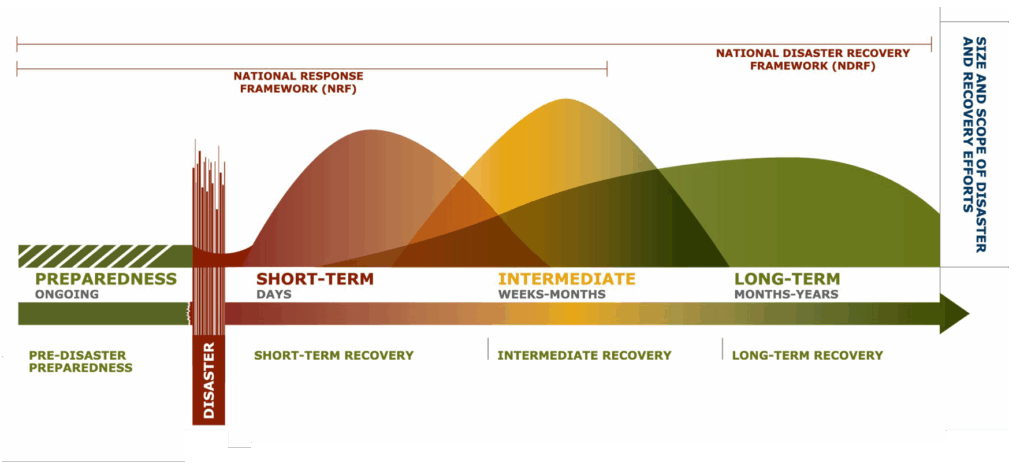
TGCRVOAD members participate in all phases, and the TGCRVOAD shares leadership in the Preparedness and Mitigation, Short-Term Recovery, and Intermediate Recovery phases with the local Long-Term Recovery Committees (LTRCs), supporting the LTRCs in Intermediate and Long-Term recovery.
TGCRVOAD and FEMA Doctrine
FEMA sets the national doctrine. VOADs operationalize it at the community level—through coordination, collaboration, and equitable service delivery across the full disaster cycle: preparedness, response, recovery, and mitigation.
The National Response Framework (NRF) defines how the nation responds to disasters and clarifies roles for government, nonprofits, and the private sector.
Emergency Support Functions (ESFs) define disaster response roles and responsibilities across federal agencies, states, local governments, NGOs, and the private sector. Each ESF is a functional mission area—like ESF#6 (Mass Care, Communications, Public Works, Transportation, Logistics) or ESF#15 (External Affairs -joint messaging, rumor control, community outreach) and has designated lead agencies and supporting partners. The organization reinforces VOAD priorities: coordination, communication, unity of effort, no duplication.
The National Incident Management System (NIMS) & Incident Command System (ICS) establish the common language, structure, and resource-typing used by emergency managers AND the VOAD. The TGCRVOAD aligns with the principles of ICS 100, 200, 700, and 800; structures intself around mission-typed volunteer teams (chainsaw, muck & gut, feeding, sheltering, assessment, standardized resource requests & EOC integration.
The Whole Community Doctrine is FEMA’s core philosophy that disasters are best managed when solutions are locally led and supported by government through strong partnerships with nonprofits, faith communities, civic groups, and the private sector to ensure equitable, accessible, community-rooted outcomes.
The National Mitigation Framework (NMF) guides VOADs to strengthen community resilience year-round by supporting preparedness, mitigation, and risk-reduction efforts that protect vulnerable populations.
The National Disaster Recovery Framework (NDRF) defines the Recovery Support Functions that guide VOAD roles in long-term recovery—such as housing, health and social services, infrastructure, economic recovery, and natural/cultural resources—and provides the foundation for LTRGs, disaster case management, and unmet needs committees.
The FEMA Strategic Plan (2022–2026) sets three priorities that directly shape VOAD planning—advancing equity (meeting the needs of underserved communities and removing access barriers, strengthening climate resilience (community readiness and mitigation), and building national preparedness through expanded partnerships and volunteer capability.
FEMA Mass Care & Individual Assistance (IA) Guidance outlines national standards for sheltering, feeding, reunification, pets, disability integration, and Individual Assistance, providing the framework for VOAD roles in shelter support, feeding, assessments, navigation, case management, and resource coordination.
Types of Disasters for TGCRVOAD Response
The TGCRVOAD prepares to respond to diverse types of disasters.
| Natural Disasters | Man-Made Disasters |
| The National Risk Index (NRI) indicates the Texas Gulf Coast is at very high risk for certain natural disasters, including hurricanes and tropical storms, tornadoes, lightning (and related fires), riverine (such as bayou) flooding, and winter weather and cold waves. We are also at relatively high risk for strong wind events, heat waves, and drought. | Man-made disasters we may need to support include active shooters, hazardous materials and chemical emergencies, public health crises, radiological emergencies, structure fires, terrorism, and utility outages. |
Scalable
We understand that disasters come in different sizes. Therefore, our responses need to be adaptable enough to manage small incidents involving a few of our Members and a Partner, as well as large incidents involving most of our Members and Partners.
Members and Partners
The TGCRVOAD includes voluntary organizations, nonprofit organizations, and community-based groups (Members), and government agencies (Partners).
The TGCRVOAD’s role is coordination. We can notify our Members of potential or likely threats and disasters, and ask them to activate or deploy but cannot compel them to follow a particular course of action.
Focus on the 4C’s
TGCRVOAD provides a forum that promotes cooperation, communication, coordination, and collaboration to foster the effective and efficient delivery of Member services.
Cooperation
We recognize that no single organization has all the solutions for every challenge that arises during disasters. Our Members and Partners understand that by working together, acting as partners, and learning from each other, we can respond more effectively to a disaster and help rebuild a community. We promote a spirit of cooperation among all TGCRVOAD Members, Partners, and government.
Coordination
We seek to match resources and services to needs by recognizing the strengths and assets of each Member and Partner organization. We strive to coordinate our responses We aim to match resources and services to needs by recognizing the strengths and assets of each Member and Partner organization. We work to coordinate our responses and provide effective service to the impacted community rather than competing.and provide effective service to the impacted community rather than working competitively.
Communication
TGCRVOAD members and partners regularly share information about their capacities, accomplishments, and commitments. As a network, TGCRVOAD promotes and facilitates this sharing, creates opportunities for listening, and maintains an open channel to address concerns.
Collaboration
By forming strategic partnerships and setting shared goals, our Members and Partners collaborate on specific projects that help achieve these objectives.
1.7 Service Area
Our members are actively involved in short-term disaster recovery across some or all of the thirteen counties within the Houston-Galveston Area Council (HGAC): Austin, Brazoria, Chambers, Colorado, Fort Bend, Galveston, Harris, Liberty, Matagorda, Montgomery, Walker, Waller, and Wharton.Our Members are active in disaster short-term recovery in some or all of the thirteen counties of the Houston-Galveston Area Council (HGAC) – Austin, Brazoria, Chambers, Colorado, Fort Bend, Galveston, Harris, Liberty, Matagorda, Montgomery, Walker, Waller, and Wharton.
We serve a community of 7.5 million people. Sixty-four percent, or 4.8 million people, live in Harris County. Urban sprawl from Houston increases the populations of Fort Bend, Montgomery, Brazoria, and Galveston Counties, where 2.3 million people, or thirty-one percent of our service area, reside. In contrast, five percent of our population lives in rural Liberty, Walker, Waller, Chambers, Wharton, Matagorda, Austin, and Chambers counties.
1.8 Capabilities
Every TGCRVOAD Member has one or more capabilities to provide resources and services to victims of natural and man- made disasters. Capabilities are the tools in our toolbox. Our tools include sheltering, mucking and gutting services, emergency distribution of food, counseling services, volunteer management, and many others.
Our documented capabilities serve as building blocks for regional disaster planning. Local Emergency Managers at the regional, county, or municipal level can anticipate what capabilities they might need under different disaster scenarios.
Together, we can plan for how the TGCRVOAD Members will become extensions of the local OEM structure, address any identified capabilities that are gaps, and learn to work with each other.
The TGCRVOAD continuously tries to expand its capabilities, paying particular attention to the jurisdictions we serve and the resources and services they anticipate calling on us to provide and coordinate.
1.9 Standard Tasks and Processes
TGCRVOAD works with its Members to define standard tasks and processes to coordinate and deliver resources and services efficiently to individuals, families, and communities. During Blue Sky days we develop and document procedures and offer training for our Members.
1.10 Regional Planning
As jurisdictions plan for disaster response and recovery, we anticipate each jurisdiction will identify specific resources and services that might be overwhelmed in a disaster. The resources and services they identify comprise that anticipated ask on the TGCRVOAD and its Members.
The TGCRVOAD will compare these anticipated needs to our capabilities. We will determine if our Members have the required capabilities in sufficient volume to satisfy the anticipated demand or if a gap in capability or ability to deliver sufficient volume exists.
As we identify gaps in our capabilities, we will work with the jurisdictions and our communities to close the gaps by
- determining if one or more of our Members can step in to fill the gap,
- recruiting voluntary organizations and nonprofits with the desired resources and services to join the TGCRVOAD, or
- advocating for the creation of voluntary organizations or nonprofits to fill the gaps.
The TGCRVOAD is committed to working with each of our jurisdictions to coordinate our capabilities to adapt to the specific requirements of each jurisdiction
1.11 Activation
Activation – RFA
Local jurisdictions can handle most emergencies or disasters without requesting outside help. In cases where local resources are exhausted or inadequate, TGCRVOAD Members can be asked for assistance through a Request for Assistance (RFA).
To avoid overwhelming the Emergency Manager/Office of Emergency Management (EM/OEM), it is important that TGCRVOAD and its Members refrain from initiating response or short-term recovery operations until we are asked to deploy.
During a short-term recovery program, the focus of the TGCRVOAD is to help coordinate the activities of our members to address the needs outlined in the RFA effectively. Our Members also provide valuable information about the situation on the ground that can supplement the EM/OEM’s situational awareness.
Activation – Other
The TGCRVOAD may also activate in anticipation of receiving an RFA resulting from a significant event, such as a major hurricane, or when one or more members ask for its assistance with cooperation, communication, coordination, and collaboration.
1.12 Objective when Activated
When asked for assistance, the primary objectives of the TGCRVOAD are to:
- Mobilize as quickly as possible,
- Effectively address as many of the needs defined in the Request for Assistance as possible,
- Reduce any duplication of efforts,
- Draft a Course of Action so that members can better coordinate assistance for the communities impacted,
- Solicit community involvement in recovery planning,
- Identify unmet needs not explicitly identified in the original RFA
- Gather and disseminate information quickly and with credibility,
- Focusing on the most vulnerable individuals, families, and communities, and
- Accomplish a smooth handoff to the LTRCs to minimize the economic disruption and the time between the disaster and recovery.
1.13 Alert Levels and Activation Triggers
TGCRVOAD leadership has established alert levels to communicate operational readiness quickly. The chair, vice-chair, or executive committee determines the alert levels.
The determination of the alert level is made considering:
- the timing of the disaster,
- whether the disaster is foreseen or unforeseen,
- the request(s) for assistance received or anticipated, and
- the likely course of action.,
TGCRVOAD could move linearly from Alert Level 4 to 3 to 2 to 1 OR jump directly from Alert Level 4 to 1.
Note that TGCRVOD could be in multiple alert levels at once. For example, we could be transferring responsibilities for disaster response to the LTRC (level 4), responding to a disaster (level 1), and monitoring or standing by for another response (Level 2 or Level 3).
1.14 Situational Brief
The TGCRVOAD announces changes in alert levels in a Situation Brief that is communicated to all Members and Partners that might be impacted. The Brief has three parts:
- The change in alert level,
- A description of the potential threat or hazard, including the current situation, the nature of the threat, the forecasted development of the threat, and the potential impact and response that might be required.
- A summary of the actions being taken by the TGCRVOAD, including any conference calls, and recommendations for actions to be taken by the Members, including monitoring or preparation.
1.15 TGCRVOAD Activities – Blue Sky Days
During normal operations or “Blue Sky” days, the TGCRVOAD concentrates on helping members conduct Mitigation and Preparedness operations, building our network, and preparing for our eventual deployment during short- and intermediate-term recovery through programs, training, and education.
Support Mitigation and Preparedness Operations
During Blue Sky days, the TGCRVOAD will actively seek out requests for assistance with mitigation or preparedness projects. These requests will then be forwarded to our Members, who have the option to accept or reject them. Our Members may also search for and commit to mitigation or preparedness opportunities. The TGCRVOAD will activate only when one or more Members requests our assistance.
Building Our Network
We work to enlarge and strengthen our network by,
- recruiting and welcoming new Members involved in short-term recovery,
- advocating for all Members and Partners
- striving to establish strong connections with Long-term Recovery Committees, and
- creating and strengthening partnerships with county and municipal emergency managers and recruiting them as Partners.
Programs, Training, and Education
We take advantage of Blue-Sky days to prepare for the Grey-Sky days. Our work in the short-term and intermediate recovery phase is built upon a foundation of program development, training, and education conducted in Blue Sky days.
The chart below outlines the general activities that the TGCRVOAD and VOADs take during Blue Sky days.
| TGCRVOAD | Members and Partners | |
| Normal Operations (Level 4) | Mitigation & Preparedness Program | Normal operations |
| Development, Training and Education | Actively participate in program development, training, and education | |
| Work on 4Cs: Cooperation Communication, Coordination, and Collaboration | Work on 4Cs: Cooperation Communication, Coordination, and Collaboration | |
| Participate in disaster response and recovery exercises sponsored by our Partners and TGCRVOAD | Participate in disaster response and recovery exercises sponsored by our Partners and TGCRVOAD | |
| Advocacy for our Members | ||
| Build our Network of Members, Partners, and LTRCs) | ||
1.6 Grey Sky Days
During “Grey Sky” days, the TGCRVOAD focuses on responding to disasters and facilitating short-term recovery efforts.
Alert Levels
We use Alert Levels to prepare for response/short-term recovery operations and to transition smoothly from Normal Operations (Level 4) to Situational Awareness (Level 3), Standby (Level 2), and Activated (Level 1). Transition to the LTRC(s) is the last step as we complete response/short-term recovery tasks, handoff responsibility to the LTRCs, and return to Normal Operations. Alert Levels help our Members stay synchronized and execute the same play in the playbook.
Request for Assistance / Activation
We caution against self-deployment and are guided by the Emergency Manager’s formal Request for Assistance (RFA) to activate. We also activate when one or more Members or a community group asks us to activate and assist with cooperation, communication, coordination, or collaboration.
Coordination Conference Calls
When activated, the Chair/Vice-Chair/Executive Committee communicates the details of the RFA to the membership. We work with the requestor to determine a preliminary Course of Action (COA) and schedule a Coordination Conference Call (CCC).
At the CCC meeting, we go over the situation, RFA, and planned course of action (CoA). Once we confirm that all members are on board with the planned CoA, Members share a brief overview of their progress, upcoming activities, and identify any resources needed or unmet needs that have been identified.
The CCC serves as a vital platform for exchanging information between the EM/OEM and the TGCRVOAD Members and among our Members. Our success in working together relies on the foundation of open communication, allowing us to cooperate, coordinate, and collaborate effectively.
Situation Reports (SITREPS)
Depending on the complexity of the response and the number of Members serving, we may ask for more formal periodic Situation Reports (SITREPS) from our Members.
OEM Representative
Last, if requested, a representative of the TGCRVOAD can deploy to the EM/OEM to assist with coordinating the VOAD response.
Transition to Intermediate/Long-Term Recovery
The majority of TGCRVOAD Members fare also active in intermediate and long-term recovery. However, in most counties, the coordination of Intermediate/Long-Term Recovery is managed by the local Long-Term Recovery Committee (LTRC). The TGCRVOAD is dedicated to ensuring a seamless transition from Short-Term Recovery to Intermediate/Long- Term Recovery. We will work to share all information that might be helpful to the LTRC(s) with them and will support the LTRC activities.
Last, we are committed to learn from each activation and will conduct After Action Reviews to better understand what went well and where we need to improve.
The chart below outlines the general activities that the TGCRVOAD and VOADs take during Grey Sky days when responding to foreseen and unforeseen disasters.
| Activation Level and Definition | ACTIONS | |
| Situational Awareness (Level 3) One or more threats that could require a response are ne or more threats that could require a response are identified and classified as potentially needing a TGCRVOAD responseidentified and classified as possibly requiring a TGCRVOAD response | TGCRVOAD – EC: 1. Issue a Situational Brief to all members, partners, guests, and volunteer partners. Identify the threat, the potential recovery actions, and provide guidance for members, partners, guests, and volunteer partners. 2. Monitor the potential threat(s) and identify the need to raise the Alert Level 3. Begin preliminary planning for a Pre-Event Collaboration Call VOADS 1. Continue Normal Operations 2. Begin periodic monitoring of the threat as recommended TXGCVolunteers | V |
| Standby (Level 2) One or more threats are identified as likely to require an TGCRVOAD response | TGCRVOAD – EC: 1. Issue a Situational Brief to all members, partners, guests, and volunteer partners. Identify the threat, the potential recovery actions, and provide guidance for members, partners, guests, and volunteer partners. 2. Monitor TGCRVOAD activities and assist with coordination activities as required odify normal operations as required Stage resources and take other steps required to reduce the time to respond quickly as RFAs are made and received | |
Standby (Level 2)
Monitor VOAD activities and assist with coordination activities as required
Modify normal operations as required Stage resources and take other steps required to reduce the time to respond quickly as RFAs are made and received
Activated (Level 1)
Support Member’s operations
Conduct Coordination Conference Calls
Consolidate SitReps from Members
Make SitReps to EM/OEM Coordinate with VOADS, LTRCs, EM/OEM
Conduct recovery operations
Participate in Coordination Conference Calls Submit SitReps as requested
Demobilization
Coordinate Transition to LTRCs; Support LTRCs Support LTRC operations Make SitReps as requests
Ensure a clean handoff to LTRCs and support LTRCs